
Table of Contents
Applecross Peninsula
Few places in Scotland reward the effort of getting there quite like the Applecross Peninsula. Tucked into the northwest corner of the Highlands, in the region of Wester Ross, this is a part of the country that still feels genuinely cut off from the modern world — and that’s exactly the point. For decades, the only way in or out was by boat or over the mountains, and even today the two road options into Applecross both come with a sense of occasion. One is a heart-stopping mountain pass with hairpin bends and 20% gradients. The other hugs a dramatic sea loch coastline with views toward the Isle of Skye. Neither route is boring.
The Applecross Peninsula sits at the heart of the North Coast 500, Scotland’s answer to Route 66, and for many drivers it’s the single stretch of the whole loop they remember most vividly. But this isn’t a destination built purely around one famous road. Applecross village itself is a scattering of whitewashed cottages facing the sea, home to one of the best-known pub kitchens in the Highlands, a scattering of self-catering cottages, and a slower pace of life that’s increasingly hard to find. Beyond the village, the peninsula opens out into a landscape of empty beaches, peat-brown lochans, ancient woodland, and hiking paths that were once the only way locals could reach each other’s townships.
This guide covers everything you need to plan a visit to the Applecross Peninsula, whether you’re stopping for a single afternoon on a North Coast 500 road trip or basing yourself here for several days. You’ll find practical detail on driving the Bealach na Bà safely, the gentler coastal alternative, where to eat and sleep, the best walks for different fitness levels, and honest advice on things that catch visitors out — patchy mobile signal, unpredictable weather, and a shortage of fuel stops being three of the big ones.
Applecross rewards travelers who come prepared and don’t rush it. This is not a place to tick off in twenty minutes from a car window. Give it the time it deserves, and it tends to become one of those Highland stops people talk about for years afterward.
Why Visit the Applecross Peninsula
The Applecross Peninsula earns its reputation as one of the most rewarding stops in the Scottish Highlands for a simple reason: very few places pack this much scenic variety into such a small, quiet corner of the map. Within a single day you can drive one of the highest and steepest roads in Britain, walk along a golden sand beach with views to Skye, wander through woodland gardens planted more than two centuries ago, and eat freshly landed langoustines while watching the sun drop behind the Cuillin ridge.
Part of the appeal is genuine remoteness. Applecross is not somewhere you pass through by accident. The peninsula sits well off the main Highland trunk roads, and reaching it requires a deliberate detour — either over the Bealach na Bà or along the northern coastal route from Shieldaig. That barrier to entry keeps visitor numbers lower than better-known Highland honeypots, even during peak North Coast 500 season, and it means the beaches, viewpoints, and walking trails rarely feel crowded.
The scenery itself is the other draw. From the summit of the Bealach na Bà, on a clear day, the view stretches across the Inner Sound to the jagged outline of the Cuillin mountains on Skye, with Raasay, Rona, and sometimes the Outer Hebrides visible beyond. Applecross village looks out over the same stretch of water, warmed slightly by the Gulf Stream, which explains the surprisingly mild microclimate and the palm trees that sometimes grow in sheltered gardens this far north.
Wildlife is another reason people return. The peninsula is home to pine martens, otters, and red deer, along with a wide variety of bird life, and the fortunate and observant may spot a golden eagle overhead. Porpoises and occasional whales pass through the Inner Sound, and seals are a common sight hauled out on rocks near the northern beaches. Expedia
Finally, there’s a strong sense of history here. Applecross was the site of one of Scotland’s earliest Christian monasteries, founded in the seventh century, and the old drovers’ road over the Bealach na Bà was used for generations to move cattle to market long before it became a tourist route. Visiting the Applecross Peninsula isn’t just a scenic drive — it’s a look at a way of Highland life that has barely changed shape, even as the road surface has improved.
Getting to the Applecross Peninsula
There are two ways onto the Applecross Peninsula by road, and choosing between them is one of the first decisions any visitor needs to make. Both start from the small settlement of Tornapress (also signposted as Kishorn), just off the A896 near Lochcarron.
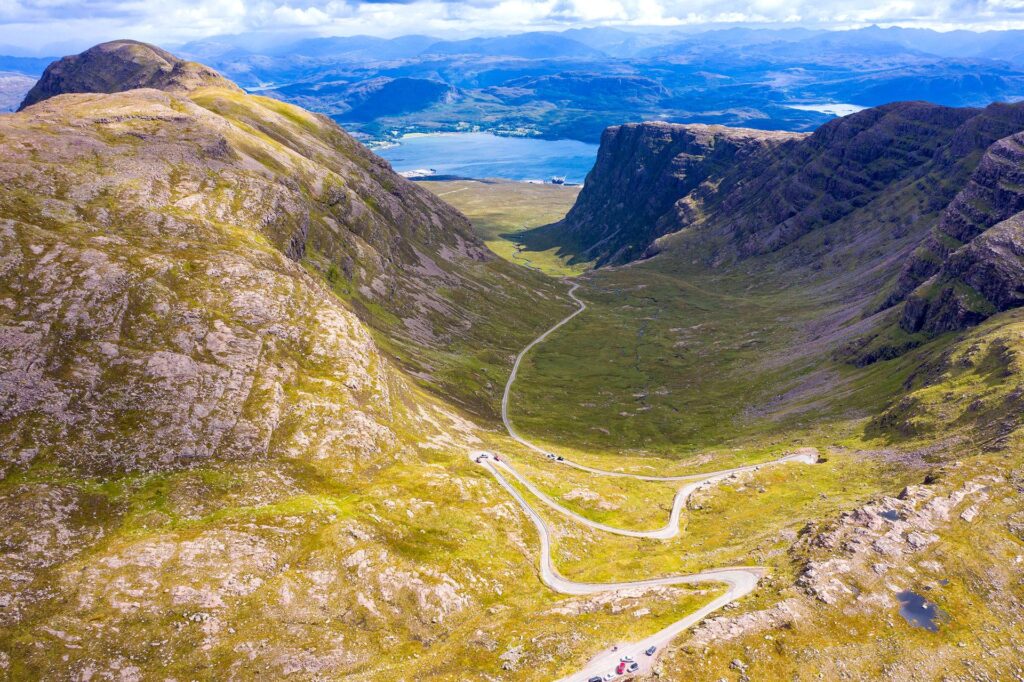
The first and most famous option is the Bealach na Bà, a single-track mountain pass that climbs to 626 metres over roughly 9 kilometres, making it the third-highest road in Scotland and the steepest ascent of any road in the UK. It’s an exhilarating drive, but it demands full concentration, a vehicle in good mechanical condition, and settled weather. The road is not suitable for learner drivers, and large motorhomes, caravans, and long campervans are prohibited outright due to the tight hairpin bends and steep gradients.
The second option is the northern coastal road, which runs from Shieldaig around the top of the peninsula before dropping down into Applecross village from the north. This route is longer in distance but far gentler in gradient, following the coastline with sea views most of the way. It’s the recommended route for larger vehicles, nervous drivers, or anyone visiting when the Bealach na Bà is closed by snow or ice, which happens most winters.
A popular approach used by many visitors is to combine both roads into a loop: climb the Bealach na Bà on the way in, spend time in Applecross village and along the coast, then leave via the gentler northern road toward Shieldaig and Torridon (or vice versa). This avoids repeating the same drive twice and gives you the best of both routes.
Public transport to Applecross is extremely limited, and most visitors arrive by car or campervan (subject to the size restrictions above). The nearest railway stations are at Strathcarron and Achnasheen, both roughly 40 minutes’ drive away, with connecting bus services that run only a few times a week. If you don’t have your own vehicle, a taxi transfer or organized Highland tour is realistically the only reliable way in.
Fuel is worth planning ahead of time. Applecross village has a small filling station, but it’s wise not to rely on it exclusively — fill up at Lochcarron or Kyle of Lochalsh beforehand, particularly if you’re driving a larger vehicle or plan to explore the peninsula’s minor roads extensively.
Bealach na Bà: Scotland’s Highest Mountain Pass
No visit to the Applecross Peninsula is complete without at least discussing the Bealach na Bà, even if you ultimately choose the coastal alternative. The name is Scottish Gaelic, and the road winds through the mountains of the Applecross peninsula in Wester Ross, in the Scottish Highlands, following a single-track route that passes through several dramatic corries. It links Applecross village on the west coast with Loch Kishorn to the east, joining the A896 at Tornapress near the village of Kishorn. ForresForres
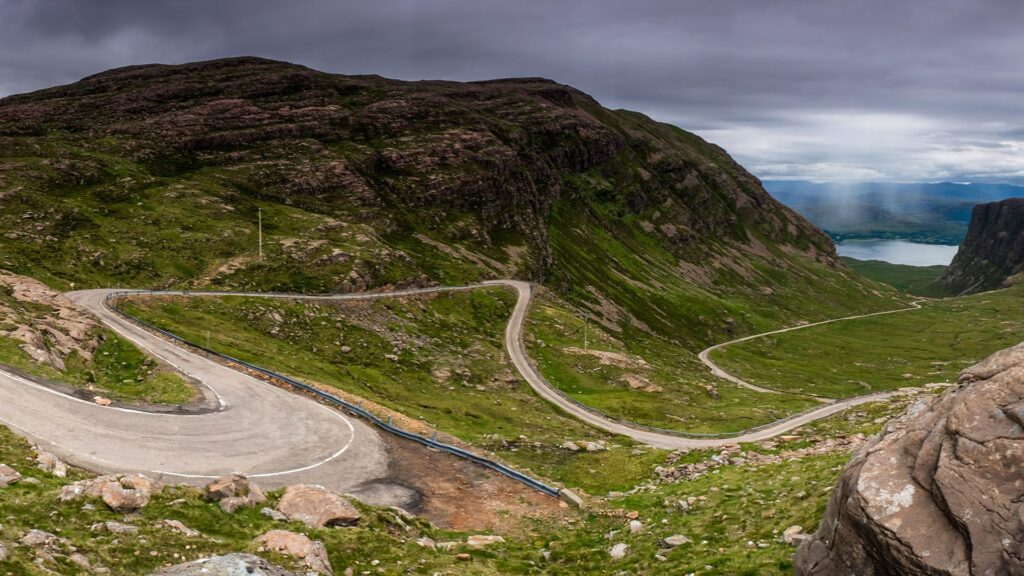
Built in 1822, the pass makes for a genuinely nerve-testing drive, with views from its 2,054-foot summit stretching to Skye, Rum, Raasay, Rona, Harris, and Lewis on a clear day. The road climbs through a series of tight hairpin bends, particularly on the eastern ascent, and drivers need to keep their attention firmly on the tarmac rather than the increasingly spectacular scenery unfolding around them. Scotland Info Guide
At the summit, a car park allows drivers to stop safely and take in the view — and it’s genuinely worth doing, both for the panorama and to let your hands recover from the climb. Cloud can roll in quickly at this altitude, so a clear day makes an enormous difference to the experience. If visibility is poor, some visitors choose to turn back and take the coastal road instead rather than descend the western side blind.
The descent into Applecross is a different character of drive altogether: the road gradually eases down through woodland belonging to Applecross House, past a walled garden and woodland track that are both open to visitors, before reaching a T-junction in the village itself. Highland Explorer
A few practical points are worth knowing before attempting the Bealach na Bà. The road is genuinely single-track for most of its length, with passing places used by both directions of traffic, so patience and courtesy matter. It’s closed periodically in winter due to snow and ice, sometimes for days at a stretch, and there’s no phone signal for much of the climb, so breakdown cover that includes remote recovery is a sensible precaution. Cyclists do take on the pass as a challenge in its own right, and drivers should watch for them on the tighter bends.
Applecross Village: History and Charm
At the western end of the peninsula sits Applecross village, the settlement that gives the whole area its name. The village is arranged as a row of whitewashed fishermen’s cottages facing across the water toward the island of Raasay, backed by wooded slopes rising behind. It’s a small, tranquil place, and much of its appeal lies in exactly that — there’s very little to “do” in a conventional tourist sense, and that’s precisely what draws people back. Expedia
The history here runs deeper than the picturesque cottages suggest. Applecross was the site of one of Scotland’s earliest Christian communities, a monastery founded in 673 AD, and the name itself is a corruption of Apor Crossan, meaning mouth of the river Crossan. For centuries afterward, the village remained largely isolated, reachable only by sea or over the mountain pass, which shaped a self-contained way of life that still colours the place today. Expedia
Modern Applecross is small but well equipped for visitors. There’s a village store, post office, and filling station, along with a handful of places to eat, sleep, and browse. Fresh shellfish and croft-grown vegetables are sold locally, and the Applecross Inn has built a strong reputation for local seafood, alongside The Potting Shed Cafe in the walled garden of Applecross House. Expedia
The Applecross Walled Garden is worth building time into your visit for. Originally part of the wider Applecross House estate, it now combines cultivated garden space with a cafe and small shop, and makes for an easy, gentle stop after the tension of driving the Bealach na Bà. Woodland paths lead from the garden through the surrounding estate, connecting to some of the peninsula’s easier walking routes.
Applecross also has a small photographic gallery showcasing images of the peninsula’s landscapes and wildlife, and a heritage centre that runs seasonally, offering context on the area’s crofting history, the old drove roads, and the monastery that once stood here. Between the village’s food, history, and outlook over the water to Skye and Raasay, it’s easy to end up staying far longer in Applecross than originally planned.
Best Things to Do on the Applecross Peninsula
Beyond the drive itself and the village, the wider Applecross Peninsula holds a good spread of things to see and do, most of which favour slow exploration over a packed itinerary.
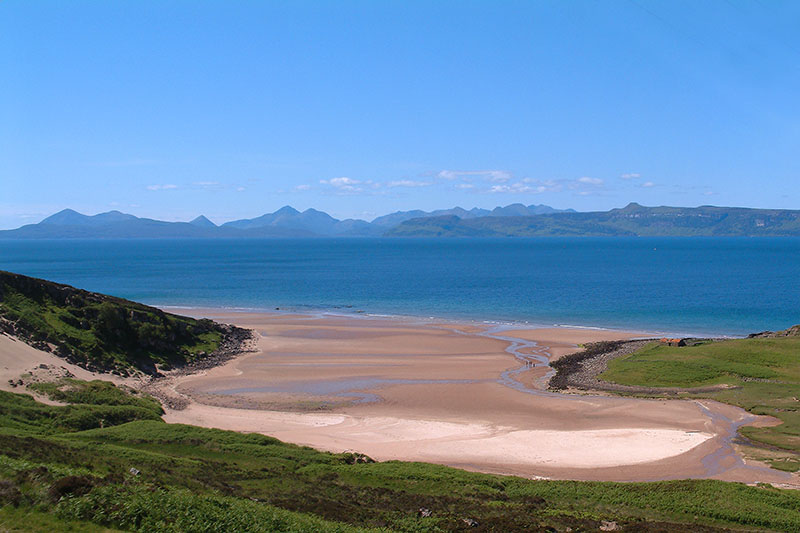
Sand Beach is one of the peninsula’s standout spots, found on the north side reached by a single-track road from the village. On a clear day the sand looks almost white, though the water itself is proper North Atlantic and rarely warm enough for a swim without a wetsuit. Seals frequently haul out on the rocks at low tide, and the beach is often empty even in the height of summer. Parking is available in a small car park with a short walk down to the sand, and there are no facilities, so bring what you need. Traveling Savage
The Toscaig walk is a good option for anyone wanting a proper stretch of the legs without a full mountain day. It’s roughly a 6-mile round trip along the coast from Applecross village to the small hamlet of Toscaig, with views of Skye and Raasay for most of the route. The path is generally clear but can be boggy in places, and Toscaig itself amounts to about ten houses and a small harbour, with the sense of remoteness being much of the appeal. Allow three to four hours and wear proper boots. Traveling Savage
Wildlife watching is worth building into any visit, even informally. Pine martens, otters, and red deer are present across the peninsula, along with a wide range of bird life, and golden eagles are occasionally spotted by patient visitors. Porpoises and, less predictably, whales can sometimes be seen out in the Inner Sound. Early morning and dusk tend to offer the best chances, particularly along quieter stretches of coastline away from the village. Expedia
The Applecross Walled Garden and Arboretum Trail offers an easier, family-friendly alternative to the coastal walks. The route passes the walled garden itself, planted originally in the eighteenth century, and continues through mixed woodland with information on the estate’s tree collection.
Watersports are increasingly available for visitors wanting to get out on the water rather than just look at it. Kayaking and paddleboarding are offered locally along the sheltered stretches of coastline near the village, giving a different perspective on the same views drivers get from the road above.
For photographers, the combination of dramatic light, changeable weather, and open sightlines to Skye makes the peninsula a genuinely rewarding place to spend a few unhurried hours, camera in hand, without needing to travel far from the village itself.
Walking and Hiking Trails
The Applecross Peninsula is well suited to walking, with old footpaths that were, until fairly recently, the only means of reaching some coastal townships other than by sea still in use today. The area’s path network has been expanded and improved over the years, offering everything from leisurely woodland strolls to demanding routes through remote coast and glen.
For a gentle introduction, the Applecross and Walled Garden Circular is the most popular short route in the area, roughly 4.8 kilometres long with modest elevation gain, and it’s well suited to families and less experienced walkers. Starting from the car park in Applecross, the Beechwood Trail runs parallel to the road, passing Tobar Naomh (the Holy Well) and offering wide views out across the bay, before The Lost Path continues into the woodland of the Applecross estate. The Arboretum Trail then leads past the walled gardens, where a cafe provides a natural stopping point. Applecross GalleryApplecross Gallery
Beyond the easy circular routes, the peninsula opens up considerably for more experienced walkers. The Applecross Estate itself covers around 26,000 hectares of woodland, beaches, lochs, mountains, and rivers, and longer routes such as the Kenmore Applecross Circuit stretch to roughly 41 kilometres for those looking for a serious day — or multi-day — hiking challenge. Applecross Gallery
A few points are worth noting before setting out on any of the longer routes. Weather changes quickly on the peninsula, and paths that are dry in the morning can turn boggy after a shower, so proper waterproof boots are essential rather than optional. During the stalking season, typically running through autumn, access to some areas may be restricted, and the Applecross Estate Trust — a member of the South West Ross Deer Management Group — advises walkers and climbers on which areas are safe to use during this period.
For anyone wanting a guided introduction rather than heading out solo, Apple X Training runs guided walks suitable for all ages on Tuesdays, starting at the Walled Garden car park at 10:30am and finishing around 11:30am, timed to connect with morning coffee at the Walled Garden afterward.
Given the lack of mobile signal across much of the peninsula, telling someone your planned route and expected return time before heading out on longer walks is a sensible habit, particularly outside the main summer season when other walkers are less likely to be around.
Where to Stay on the Applecross Peninsula
Accommodation on the Applecross Peninsula is limited by design — this isn’t a place with rows of hotels — but there’s enough variety to suit most budgets and travel styles, provided you book ahead, especially during the busy North Coast 500 season between May and September.
The Applecross Inn is the best-known place to stay in the village itself, combining rooms with its well-regarded restaurant downstairs, making it a convenient option for anyone who wants to walk straight from dinner to bed without a drive afterward. Self-catering cottages are scattered around the village and wider estate, many of them traditional whitewashed buildings with sea views toward Raasay, and they tend to book up months in advance for peak summer weeks.
For campers and campervan travelers, Applecross Campsite is the main option on the peninsula. Situated above the village, the site occupies over six acres of open field camping space with views of the Inner Sound toward Raasay, Rona, and the Black Cuillins of Skye. It has room for around sixty units across tents, motorhomes, and touring caravans, with ten fully serviced pitches and nine electric and water points, plus heated camping huts and static caravans for those wanting more shelter during colder months. Worth noting: there is no mobile phone reception at the campsite, which the operators frame as part of the appeal, and campfires are not permitted anywhere on site. The site sits behind sleepy farm buildings, sheltered by native hazelwood, on a grassy shelf overlooking the village rooftops and a golden sand beach toward the mountains of Skye and Raasay. AllTrails + 2
Beyond the peninsula itself, several nearby villages make useful bases if Applecross’s own accommodation is full or if you’d prefer a slightly wider choice of places to eat and sleep. Torridon offers quick access to trailheads with a hotel and inn plus a small village store, and is a longstanding favourite with walkers and climbers. Kinlochewe provides a convenient base for exploring Glen Torridon or Beinn Eighe, with a hotel, bunkhouse, seasonal campsite, and small shop. Gairloch is larger again, with multiple hotels, B&Bs, and cafes that stay open later into the season, and works well if you also want easy access to beaches or short coastal walks. Applecross
Whichever option you choose, booking ahead is strongly advised. The combination of limited rooms, a genuinely remote location, and rising popularity from North Coast 500 traffic means turning up without a reservation in peak season is a real gamble.
Food and Drink
The Applecross Inn is the centrepiece of the peninsula’s food scene, and its reputation extends well beyond the Highlands. It’s an award-winning pub known for excellent local seafood, and much of what appears on the menu — langoustines, scallops, and other shellfish — is landed within sight of the building itself. Given its popularity, especially during summer evenings, arriving early or booking ahead is worth doing if you don’t want a long wait for a table. Expedia
For a quieter option, The Potting Shed Cafe, located within the walled garden of Applecross House, serves lighter meals, home baking, and coffee in a more relaxed, garden-facing setting. It’s a good midday stop, particularly if you’ve just walked one of the estate’s woodland trails and want something less substantial than a full pub meal.
The village store stocks essentials along with some local produce, including fresh shellfish and croft-grown vegetables when available, useful for self-caterers staying in one of the nearby cottages or at the campsite. Given how few shops exist on the peninsula, it’s worth picking up any specific supplies in a larger town like Lochcarron or Kyle of Lochalsh before making the final approach into Applecross.
Options thin out considerably once you move beyond the village itself, so it’s sensible to plan meals around Applecross rather than assuming you’ll find something further out on the peninsula. If you’re camping or self-catering, stocking up properly before arrival avoids any awkward gaps, particularly outside peak season when opening hours can be shorter and less predictable.
Best Time to Visit the Applecross Peninsula
Late spring through early autumn — roughly May to September — is the most reliable window for visiting the Applecross Peninsula, and it’s when the Bealach na Bà is most consistently open and clear of ice. Long daylight hours this far north mean plenty of time for driving, walking, and simply sitting somewhere quiet with a view, and wildflowers and greenery are at their fullest across the estate’s woodland trails.
That said, summer is also the busiest period, particularly with North Coast 500 traffic, so single-track sections of road and the more popular walking routes can feel considerably busier than the rest of the year. Midges, the Highlands’ famously persistent biting insects, are also most active from June through August, especially in still, damp conditions near woodland and water — insect repellent is genuinely worth packing rather than an afterthought.
Autumn brings a quieter, more atmospheric version of the peninsula, with the deer rut adding a dramatic soundtrack to walks across the estate and changing colours through the woodland. This is also when stalking restrictions apply to some walking routes, so checking with the estate before setting out on longer hikes is worth doing during this period.
Winter and early spring see accommodation options become smaller and more personal rather than disappearing altogether, and it remains entirely possible to visit, just with a bit more planning. Applecross village retains the well-known Applecross Inn, self-catering cottages, and its sea views across to Raasay and Skye, though it’s worth checking winter opening hours in advance. The Bealach na Bà closes periodically during winter due to snow and ice, sometimes for several days at a stretch, so the coastal road from Shieldaig becomes the more reliable route in. On the upside, viewpoints, beaches, and hiking trails are often entirely empty during the colder months, which suits travelers who prioritise solitude over guaranteed sunshine. ApplecrossApplecross
Whatever time of year you choose, checking a short-range weather forecast the morning of your visit — rather than relying on anything booked days in advance — makes a real difference to how much you get out of the Bealach na Bà summit view in particular.
Practical Travel Tips for Applecross Peninsula
A handful of practical details make a real difference to how smoothly a visit to the Applecross Peninsula goes, and they’re worth reading before you set off rather than discovering on the road.
Mobile signal is patchy to non-existent across large parts of the peninsula, including the Bealach na Bà and the Applecross Campsite. Download offline maps in advance, let someone know your rough plans, and don’t rely on being able to call ahead for accommodation or restaurant bookings once you’re on the peninsula itself.
Fuel and supplies are limited. Applecross village has a small filling station and shop, but it’s sensible to top up fuel and buy any specific supplies at Lochcarron, Kyle of Lochalsh, or another larger town before making the final approach, particularly outside peak season when local opening hours can be shorter.
Vehicle size restrictions apply specifically to the Bealach na Bà. Motorhomes, caravans, and large campervans are prohibited due to the road’s steep gradients, narrow width, and sharp hairpin bends, and even mid-size campers can struggle, so drivers of larger vehicles are advised to take the coastal route via Shieldaig instead. Wikipedia
Weather and driving conditions change quickly, especially at altitude on the Bealach na Bà. Clear mornings can cloud over within an hour, and the summit is often the last place to know it until you’re there. If conditions look poor, the coastal road is always a safer fallback.
Wild camping is generally discouraged on parts of the estate, and using the designated campsite or booked accommodation is the more straightforward and respectful option given the working nature of much of the land.
Packing for layers matters more here than in most parts of the UK. Even in summer, exposure at the Bealach na Bà summit can be significantly colder and windier than at sea level in the village, so a waterproof layer and warm mid-layer are worth having in the car regardless of the forecast. Wikipedia
Booking ahead applies to almost everything — accommodation, and a table at the Applecross Inn during peak summer evenings in particular — given how limited capacity is across the whole peninsula.
Nearby Places to Explore
The Applecross Peninsula sits within easy reach of several other standout parts of the northwest Highlands, making it easy to combine with a wider Wester Ross or North Coast 500 itinerary rather than visiting in isolation.
Torridon, just north of Applecross via the coastal road through Shieldaig, is one of Scotland’s most celebrated walking and climbing areas, with dramatic sandstone peaks including Liathach and Beinn Eighe rising almost directly from sea level. It pairs naturally with an Applecross visit, particularly for hikers wanting a bigger mountain day after the gentler peninsula trails.
Shieldaig, a small fishing village on the coastal road between Applecross and Torridon, is worth a stop in its own right, with a pretty harbour, a wooded island just offshore, and a couple of good places to eat.
Skye, visible across the water from almost every viewpoint on the Applecross Peninsula, is reachable via a longer drive around through Kyle of Lochalsh and the Skye Bridge, and makes sense as a multi-day extension for anyone with extra time. [Internal Link: Relevant Adventrova.com article on the Isle of Skye]
Lochcarron, the settlement nearest the eastern start of the Bealach na Bà, is a practical stop for fuel, supplies, and a night’s accommodation if you’re timing your Applecross visit around the pass itself.
Gairloch, further north up the coast, offers a larger range of accommodation and dining options along with its own beaches and short coastal walks, making it a useful alternative base for a longer Wester Ross road trip.
Combining two or three of these into a wider loop is the most efficient way to see this corner of the Highlands without excessive backtracking, and it spreads accommodation demand across a wider area during busy summer months.
Applecross Peninsula: Quick Facts
| Information | Details |
|---|---|
| Location | Wester Ross, northwest Scottish Highlands |
| Best for | Scenic driving, walking, wildlife, remote getaways |
| Recommended visit length | 1 full day minimum; 2–3 days to explore properly |
| Bealach na Bà summit height | 626 metres (2,054 feet) |
| Vehicle restrictions | No large motorhomes, caravans, or long campervans on Bealach na Bà |
| Best time to visit | May to September for reliable road access; quieter in autumn/winter |
| Mobile signal | Very limited to non-existent across most of the peninsula |
| Nearest fuel/rail | Lochcarron and Strathcarron, roughly 40 minutes’ drive |
Frequently Asked Questions
Is the Bealach na Bà safe to drive?
Yes, for most drivers in normal conditions, though it demands full attention. The road is single-track with tight hairpin bends and steep gradients, and it’s not suitable for learner drivers or large vehicles. Clear, dry weather makes a significant difference, and the coastal route via Shieldaig is a safer alternative if conditions look poor or you’re driving a larger vehicle.
Can you take a motorhome over Bealach na Bà?
No. Motorhomes, caravans, and large campervans are prohibited due to the road’s steep gradients, narrow width, and sharp hairpin bends. Even mid-size campers can struggle, and drivers of larger vehicles are advised to use the gentler coastal road from Shieldaig instead.
How long does it take to drive around the Applecross Peninsula?
The core loop combining the Bealach na Bà and the coastal road can be driven in around three hours without stops, but a full day is recommended to properly enjoy the viewpoints, beaches, and village along the way.
Is there mobile phone signal on the Applecross Peninsula?
Signal is very limited to non-existent across most of the peninsula, including the Bealach na Bà and Applecross Campsite. Download offline maps and let someone know your plans before setting out, particularly for longer walks.
Is Applecross dog-friendly?
Yes. Dogs are welcome at Applecross Campsite and along most of the peninsula’s walking trails, generally on a lead, particularly during the stalking season when livestock and wildlife management are active.
What’s the best beach on the Applecross Peninsula?
Sand Beach, on the north side of the peninsula reached by a single-track road from the village, is the standout choice, with pale sand, views toward Skye, and frequent seal sightings at low tide.
Do I need to book accommodation in advance?
Yes, strongly recommended. Accommodation on the peninsula is limited, and both the Applecross Inn and Applecross Campsite fill up well in advance during the busy May to September season.
Suggested Two-Day Applecross Itinerary
Day 1: Bealach na Bà and Applecross Village
Start from Lochcarron with a full tank of fuel, then drive the Bealach na Bà, stopping at the summit car park for photographs and a break. Descend into Applecross village, visit the Walled Garden and Potting Shed Cafe for lunch, then spend the afternoon exploring the village, the small heritage centre, and the shoreline. Book dinner at the Applecross Inn well in advance, and stay overnight at the campsite, an inn room, or a self-catering cottage in the village.
Day 2: Sand Beach, Toscaig Walk, and the Coastal Road
Begin with the drive out to Sand Beach for a morning walk along the shore and a chance of spotting seals. Back in the village, tackle the coastal walk toward Toscaig if time and weather allow, or opt for the shorter Applecross and Walled Garden Circular instead. In the afternoon, leave the peninsula via the northern coastal road toward Shieldaig, stopping for photographs along the way, before continuing on to Torridon or your next North Coast 500 stop.
Conclusion
The Applecross Peninsula asks a little more effort than most Highland destinations, and that’s exactly why it stays memorable. Getting here means committing to either a genuinely thrilling mountain pass or a slower, scenic coastal drive, and once you arrive, the reward is a village and landscape that feel meaningfully separate from the rest of Scotland’s well-trodden tourist trail.
Whether your priority is driving the Bealach na Bà for the challenge and the view, eating fresh seafood at the Applecross Inn, walking the coastal path to Toscaig, or simply finding a quiet beach with a view toward Skye, the Applecross Peninsula delivers all of it within a compact, easily explored area. Come prepared — fuel up beforehand, pack proper layers, download offline maps, and book accommodation ahead of time — and you’ll avoid the few genuine pitfalls of visiting somewhere this remote.
Give the Applecross Peninsula at least a full day, though two or three will let you see it properly. Pair it with nearby Torridon, Shieldaig, or a longer North Coast 500 loop, and you’ll come away with one of the more distinctive Highland experiences Scotland has to offer.