
Table of Contents

Quinag Walk
Quinag is the kind of hill that makes you slow the car down. Driving along the A894 in Assynt, three big sandstone buttresses rise out of the empty moor, and anyone with boots and a free day starts doing the maths. That is how every Quinag walk starts: one long look at the hill, a quick check of the forecast, and a slightly dramatic pause.
It is a bigger day than nearby Stac Pollaidh, but the payoff is just as good. From the tops, visitors can see Suilven, the sea lochs, the Atlantic coast and an enormous amount of Highland land with nobody on it. This guide covers how to get there, how the Quinag circular walk works, the seven views worth stopping for, and what to pack. A short FAQ follows at the end.
Where Quinag Is and How to Get There
Quinag sits in Assynt, in the far north-west of Sutherland. The hill rises beside the A894, a few miles south of the Kylesku Bridge, and the usual start is a small car park on the roadside. You will not have trouble finding the hill. It is the huge one with three tops, and it is hard to miss even if you try.
Parking is the first thing to plan for a Quinag walk. The car park is small, and in summer it can fill up. Arrive early, and please don’t leave a car in a passing place or on the verge. The roads here are narrow, and a badly parked car can cause real trouble for locals who actually need to get somewhere.
Driving in this part of the Highlands comes with its own rules. Use the passing places, let faster traffic by, and expect sheep. The sheep have right of way, and they know it. They will stand in the middle of the road and stare at you like you are late for an appointment with them.
There is almost no public transport nearby, so most visitors come by car. Ullapool and Lochinver are the closest places for shops and fuel, so stock up before you head out.
How the Quinag Circular Walk Works
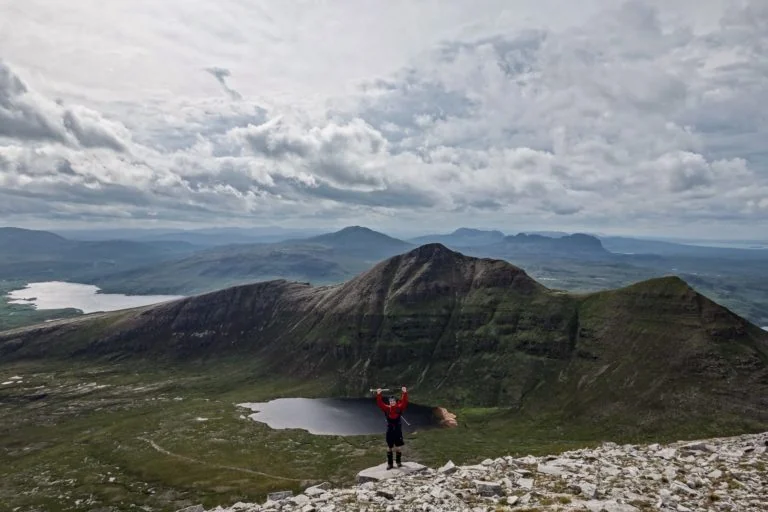
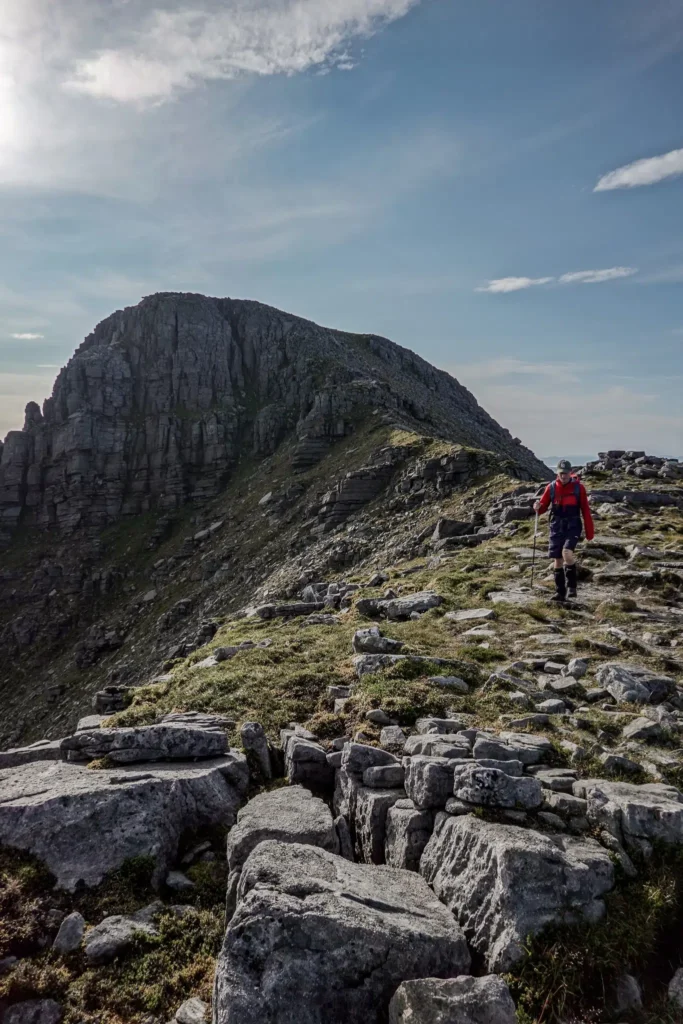
The standard route is a loop. The path leaves the car park and climbs steeply towards the ridge, then follows the crest around the hill in a big horseshoe shape. Along the way it crosses the three main tops: Sail Gharbh, Sail Gorm and Spidean Coinich. Sail Gharbh is the highest, a little over 800 metres.
The Quinag circular walk is roughly 10 km long and usually takes six to seven hours, including stops. That sounds like a lot for a hill that doesn’t look huge from the road, but the climb is steep and the ground is rough. A Quinag walk is a proper mountain day, not a gentle stroll with a café at the end of it. There is no café. There is a lot of heather.
Parts of the path are clear, and parts fade out. Visitors will need to watch where they are going, especially in poor visibility. Of the Assynt hill walk options, this is one for people who are comfortable on steep ground and already have some hillwalking experience.
The loop also gives you a choice of direction, and either way works if you take your time. Check the conditions first, because the best direction can depend on wind and cloud, and a quick look at a map before you leave will save a lot of guessing on the hill.
The 7 Best Views on the Hill
Here are the seven views visitors should aim for. A Quinag walk on a clear day can tick off all of them, and on a cloudy day it may tick off none. That is the Highlands for you.
1. Suilven and Canisp
This is the big one. To the south, Suilven rises alone from the moor with a long, steep-sided shape that is instantly recognisable. Next to it sits Canisp, a broader, gentler hill. Together they make one of the best skylines in Scotland. Most visitors take their first photo here, then a second one just to be safe.
2. The Kylesku Bridge and the Sea Lochs
Looking north, the land breaks up into sea lochs and inlets around Kylesku. On a clear day you can follow the water out towards the coast and see the bridge curving over the narrows. It is a good reminder that this part of Scotland is half hill and half sea, and the two never quite agree where one ends and the other begins.
3. Ben More Assynt and the Inland Hills
To the east, the high ground of inland Assynt stretches away, with Ben More Assynt among the biggest hills in the area. These are heavy, rough, empty mountains, and from Quinag you get a good view of their size without having to climb any of them. That is a bargain.
4. The Atlantic Coast and Handa
On a clear day, the view west opens up to the Atlantic coast. Visitors can pick out the shape of Handa Island and the long line of the shore. If the air is very clear, the sea seems to go on forever. If it is hazy, you will mostly see grey, which is still a good colour for the Highlands.
5. Stac Pollaidh and the Coigach Hills
Looking south, the jagged crest of Stac Pollaidh shows up in the distance, along with the Coigach hills. If you have already done the Stac Pollaidh walk, it is a nice moment to look back at it from a different angle. It looks smaller from here, and it knows it.
6. Loch Assynt and the Glens Below
From the southern tops, visitors can look down over Loch Assynt and the glens around it. The long water and the wide, empty land around it make the scale of the place easy to see. It is also a good spot to sit down, eat a sandwich and pretend you are not tired.
7. The Sandstone Buttresses in the Evening Light
The last view is the hill itself. Quinag’s cliffs and buttresses are made of sandstone, and they change colour as the sun gets lower, turning warm and orange in the evening. In summer the light lasts late this far north. Plan your descent properly, though. A hill this steep is not a good place to find your way in the dark.
The Ridge, the Gully and Staying Safe on Steep Ground
This is the part to take seriously. The climb to the ridge is steep, and some sections have loose rock and need a few hand moves. It is not a technical climb, but it is not a flat path either.
The edges of the hill have big drops, and cloud can come down fast. In poor visibility, it is easy to lose the path and end up near cliffs. A Quinag walk is best left for a clear day, and if the cloud is low, the sensible choice is to wait or pick a shorter hill.
A few simple rules help:
- Test every hold before you trust it. Sandstone can be loose and slippery.
- Don’t go up what you can’t get down. Going up is often easier than coming back.
- Avoid the steep sections in wet weather. The rock gets slick fast.
- Turn back if you are unsure. The hill isn’t going anywhere.
Best Time to Visit and Weather
Late spring and early autumn are usually the best times for a Quinag walk. The days are long, the air tends to be clear, and the midges are less of a problem than in high summer.
On the midges: they are small, they bite, and they come in huge groups, especially from June to September and especially on still, damp days. Repellent helps, and so does a bit of wind. Don’t stop for long in sheltered spots unless you want to find out how many there are.
The weather changes quickly here. A bright morning can turn into rain and low cloud by lunchtime, and cloud hides exactly the views you came for. Check the mountain forecast, not just the town one. Winter is a very different story. Snow and ice make the ground much more serious, and the days are short, so winter conditions are best left to experienced walkers with the right equipment.
What to Wear, Pack and Watch Out For
A Quinag walk needs proper gear. Walking boots with good grip are a must, because the ground is rough and wet in places. Trainers are not a good idea here.
A sensible pack for the day includes:
- Waterproof jacket and a warm layer, even if the car park looks sunny
- Plenty of water and food
- A map of the area, and a compass if you know how to use one
- Head torch, in case the day runs longer than planned
- Midge repellent in season
- A small first aid kit
- A charged phone, though signal is patchy in this area
Tell someone where you are going and when you expect to be back. If something goes wrong, call 999 and ask for the police, then mountain rescue. Keep dogs under control near livestock and nesting birds, take your rubbish home, and stay on the path where there is one.
Final Thoughts
A Quinag walk is long, steep and very rewarding. It gives visitors some of the best scenery in the north-west Highlands, from Suilven and the sea lochs to the Atlantic coast, and it feels remote in a way few places in Britain still do. It is the kind of day people talk about for years afterwards.
Go early, check the weather, bring the right gear and look around properly when you reach the top. And if a sheep gives you an odd look on the way back to the car, don’t take it personally. It does that to everyone.
Frequently Asked Questions
1. How long does the Quinag circular walk take?
Most people need around six to seven hours, depending on fitness, weather and how often they stop for photos.
2. Is the route suitable for beginners?
Not really. It is steep and rough, and the path can be faint in places. It is better for people who already have some hillwalking experience.
3. Where do I park?
There is a small car park beside the A894, a few miles south of the Kylesku Bridge. It fills up in summer, so arrive early and never block passing places.
4. When is the best time to go?
Late spring and early autumn usually offer clearer air, long days and fewer midges than the middle of summer.
5. Do I need a map and compass?
Yes. The path can be hard to follow in cloud, and phone signal in this part of Assynt is unreliable.