
Table of Contents
Waterfall Country Wales
Tucked into the southern edge of Bannau Brycheiniog (Brecon Beacons) National Park, Waterfall Country Wales is one of the most concentrated pockets of natural drama in the country. Along a short stretch of land between the villages of Pontneddfechan and Ystradfellte, four rivers — the Mellte, Hepste, Pyrddin and Nedd Fechan — drop through wooded sandstone gorges in a series of thundering falls, the best known of which lets you walk directly behind the curtain of water.
This guide is built for anyone planning an actual visit, whether that’s a short afternoon walk with the family or a full weekend based around the Four Falls Trail. It covers the history of the area, the best walking routes, when to go, how to get there without a car if needed, where to stay nearby, what it costs, and how to visit safely — because this is a landscape where the terrain and the water both deserve real respect.
Waterfall Country Wales rewards a bit of planning. The paths are often steep, wet and uneven, car parks fill early on weekends, and some of the most photogenic viewpoints require careful footing. Read on for everything you need to make the most of a visit, from practical logistics to the quieter corners most day-trippers miss.
Quick Facts
| Quick Fact | Information |
|---|---|
| Destination | Waterfall Country, Bannau Brycheiniog (Brecon Beacons) National Park |
| Location | South Wales, between Pontneddfechan and Ystradfellte, Powys |
| Best time to visit | Spring and autumn for manageable crowds; after heavy rain for the fullest falls |
| Recommended visit time | Half a day for one waterfall walk; a full day for the Four Falls Trail |
| Main attractions | Sgwd yr Eira, Sgwd Clun-Gwyn, Sgwd Isaf Clun-Gwyn, Sgwd y Pannwr, Porth yr Ogof |
| Getting there | Car recommended; nearest towns are Neath, Merthyr Tydfil and Brecon |
| Typical budget | Free to walk; official car parks charge for parking |
| Family friendly | Yes, with care — some sections involve steep, uneven steps near water |
| Accessibility | Limited; paths are unsurfaced, steep in places and not wheelchair accessible |
| Best for | Walkers, photographers, waterfall enthusiasts, weekend nature trips |
What Makes Waterfall Country Wales Worth Visiting?
Very few places in the UK pack this many waterfalls into such a small area. Within a few square miles around Pontneddfechan and Ystradfellte, the Rivers Mellte, Hepste, Pyrddin, Nedd Fechan and Sychryd carve through deep, tree-lined gorges before merging to form the River Neath. Nowhere else in Wales has such a density of falls in such a compact stretch of land, which is exactly why this corner of Bannau Brycheiniog National Park earned its nickname.
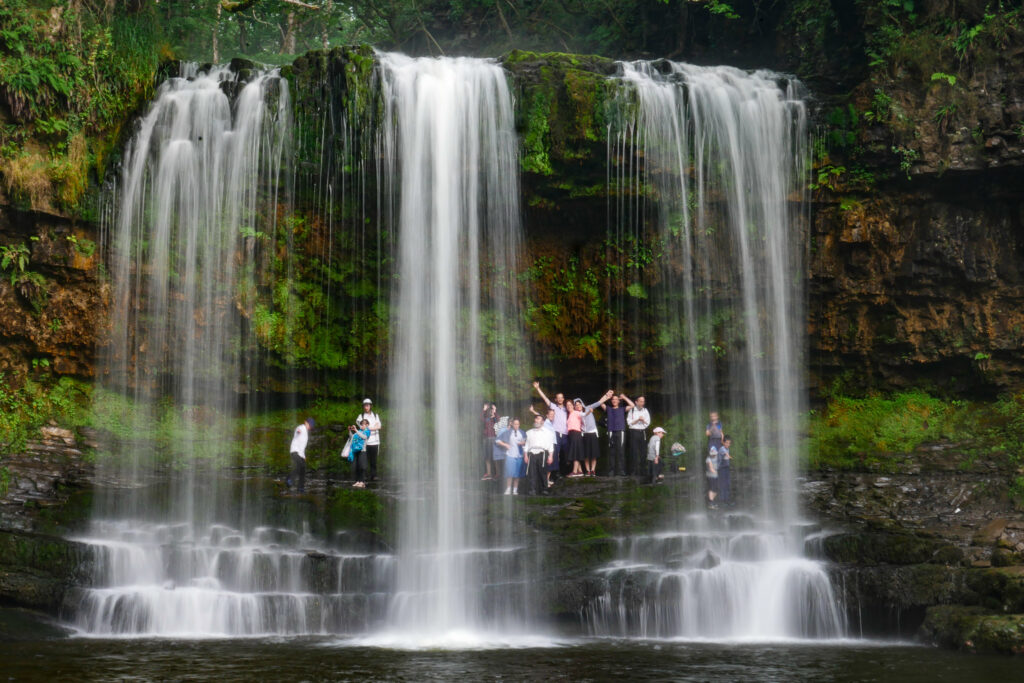
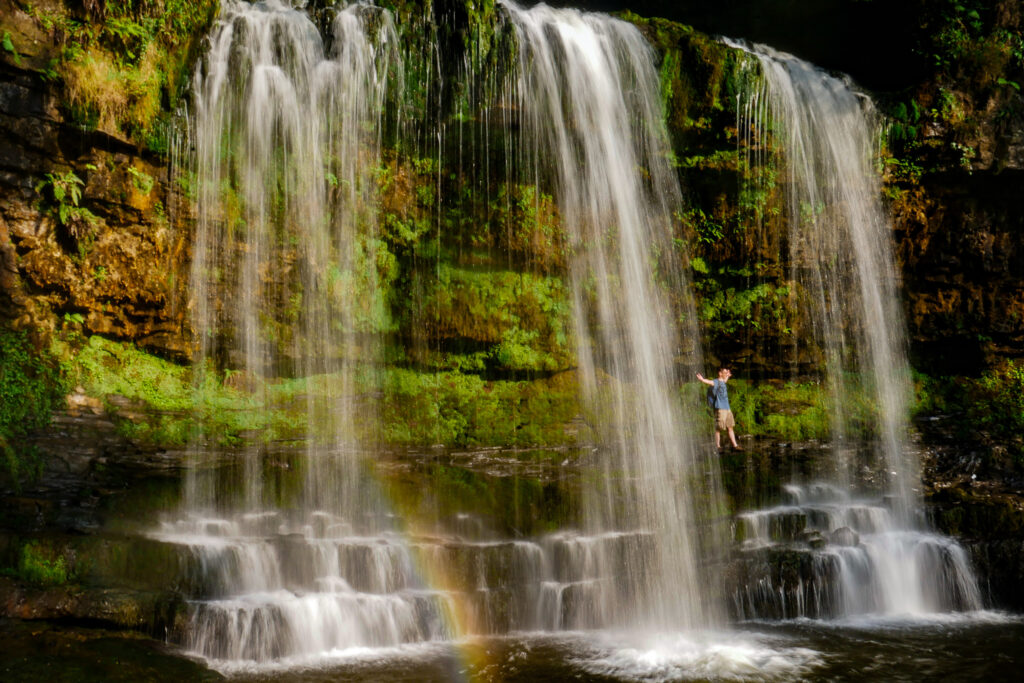
The centrepiece is Sgwd yr Eira — the Waterfall of Snow — on the River Hepste. What sets it apart from most UK waterfalls is that a rock ledge runs directly behind the curtain of falling water, so visitors can walk through and view the valley from behind the cascade itself. It’s a genuinely rare experience in British walking, and it’s the single most-photographed spot in the area for good reason.
Beyond that headline attraction, Waterfall Country rewards visitors who explore a little further. The Four Falls Trail links Sgwd Clun-Gwyn, Sgwd Isaf Clun-Gwyn, Sgwd y Pannwr and Sgwd yr Eira along the Mellte and Hepste valleys, while Porth yr Ogof offers something completely different: the largest cave entrance in Wales, where the River Mellte disappears underground before reappearing further downstream. The area is also designated a Special Area of Conservation and a Site of Special Scientific Interest, reflecting the ecological value of its ancient oak woodland, mosses and river habitats.
Who should visit? Confident walkers who don’t mind steep, sometimes muddy terrain will get the most out of a full Four Falls circuit. Families with older children can manage shorter sections with care, and photographers will find no shortage of subjects, from misty woodland light to the raw power of the falls after rain. What visitors shouldn’t expect is an easy, flat stroll — this is a working landscape of steps, tree roots and riverside paths, and it’s more rewarding when you arrive prepared for that.
The area’s appeal has grown considerably in recent years, partly through social media exposure of the walk-behind-the-waterfall experience at Sgwd yr Eira. That popularity is a double-edged sword: it means better-maintained paths and clearer signage in places, but also busier car parks and more pressure on fragile riverbanks, which is worth bearing in mind when planning a visit and choosing quieter times of day.
History and Heritage of Waterfall Country
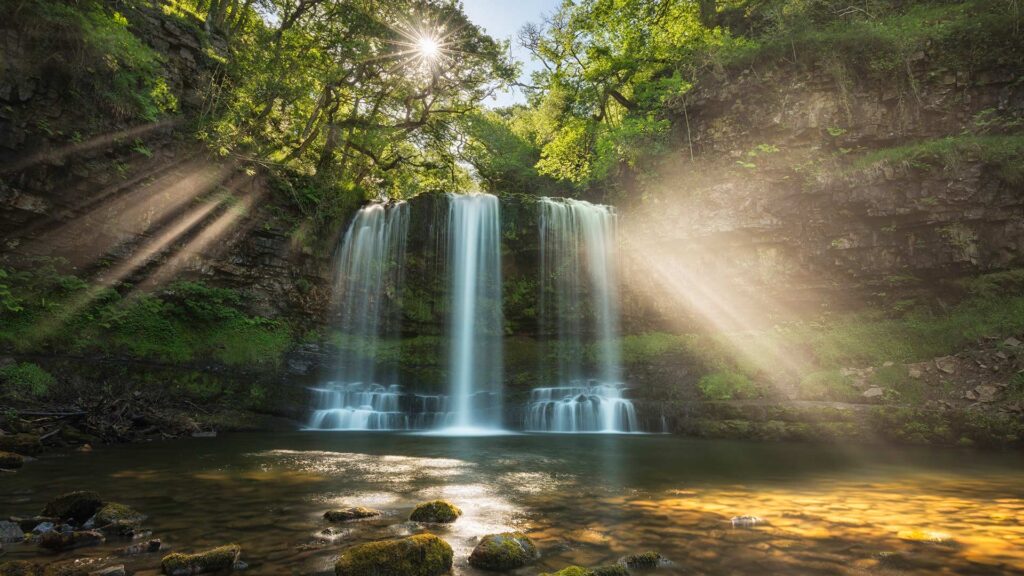
The landscape itself tells much of the story here. The gorges of Waterfall Country were cut by the Mellte, Hepste, Pyrddin and Nedd Fechan rivers through Old Red Sandstone and, further south, limestone, the same underlying geology that shapes the wider Bannau Brycheiniog National Park. Over thousands of years, the rivers eroded softer bands of rock at different rates, creating the stepped ledges and undercut curtains that produce falls like Sgwd yr Eira, where the harder rock forms an overhang and the softer rock beneath has worn away to leave a walkable path behind the water.
Human history in the area reaches back much further than its current status as a walking destination. Ystradfellte, the village at the heart of the Four Falls Trail, has a documented history stretching to the medieval period; it is chiefly known in local history as the place where the Welsh nobleman and rebel leader Llywelyn Bren surrendered at the end of his 1316 revolt against English rule. The surrounding hills and gorges were also home to generations of farming communities who used the river valleys for grazing and small-scale industry long before tourism arrived.
Industry left its own mark on the wider Waterfall Country area, particularly around Pontneddfechan, where the Neath and Dulais valleys once supported quarrying, tramroads and silica mining that fed the region’s industrial heritage. Traces of old tramways and mine workings can still be spotted by attentive walkers along some of the connecting paths, a reminder that this now-quiet woodland was once a working industrial landscape.
The caves are part of the heritage story too. Porth yr Ogof, where the River Mellte vanishes underground, has long been a site of local fascination and caution — its name translates as “gateway to the cave,” and it holds the record for the largest cave entrance in Wales. The wider limestone country to the south, around the Dan-yr-Ogof show caves, forms part of the same karst system that gives this pocket of Wales such unusual geology.
Today, the area is jointly managed by the Bannau Brycheiniog National Park Authority and Natural Resources Wales, both of which maintain the paths, car parks and signage that make Waterfall Country accessible while trying to protect its Special Area of Conservation status. The name “Bannau Brycheiniog” itself was formally restored in 2023, replacing “Brecon Beacons” as the park’s official Welsh name, though both names remain in common use among visitors and locals alike.
Best Things to Do in Waterfall Country
Walk the Four Falls Trail
The signature experience is the Four Falls Trail (also called the Four Waterfalls Walk), a roughly 5.5-mile route that links Sgwd Clun-Gwyn, Sgwd Isaf Clun-Gwyn, Sgwd y Pannwr and Sgwd yr Eira. It typically starts from either the Cwm Porth or Gwaun Hepste car parks near Ystradfellte and follows the Mellte and Hepste river valleys through dense woodland, with steep, sometimes uneven steps down to each falls viewpoint. Sturdy footwear is essential, as the ground can be slippery even in dry weather.
Walk Behind Sgwd yr Eira
Sgwd yr Eira is worth calling out on its own. The path behind the falling water is a short but memorable detour, and it’s genuinely one of the few places in Britain where you can stand behind a waterfall rather than simply look at one. Expect spray, uneven rock underfoot and, on busy days, a short queue to get behind the curtain safely.
Explore Porth yr Ogof
A short, easier walk from the Cwm Porth car park leads to Porth yr Ogof, the largest cave entrance in Wales. Visitors can view the cave mouth and watch the River Mellte disappear underground, though entering the cave system itself is only recommended for experienced, properly equipped cavers — it’s not a casual walk-in attraction.
Follow the Elidir Trail from Pontneddfechan
For a gentler alternative, the Elidir Trail starts from Pontneddfechan and links to several waterfalls along the Nedd Fechan and Pyrddin rivers, including Sgwd Gwladus and Sgwd Einion Gam. It’s less strenuous than the full Four Falls circuit and makes a good option for those wanting a shorter, quieter walk.
Visit the National Showcaves Centre for Wales
A short drive away near Ystradfellte, the National Showcaves Centre for Wales offers guided access to an extensive cave system, along with a dinosaur park and museum, making it a strong option for families wanting an indoor-outdoor mix, particularly on a wet day.
Wild Swimming (With Caution)
Some visitors swim in the calmer pools below certain falls in summer, but this area has recorded fatalities in recent years due to strong currents, sudden depth changes and cold water shock. Anyone considering entering the water should check current safety advice from the National Park Authority first and never enter directly beneath a waterfall.
Photography and Slow Exploration
Beyond the main trail, Waterfall Country rewards visitors who simply slow down — the moss-covered gorges, dappled woodland light and smaller, less-visited cascades along the Pyrddin and Nedd Fechan offer quieter photography opportunities away from the busiest viewpoints.
Best Places to Visit Near Waterfall Country
Waterfall Country sits within easy reach of several other highlights in Bannau Brycheiniog National Park and the wider South Wales valleys, making it easy to combine with other stops on a longer trip.
Pen y Fan, the highest peak in southern Britain at 886 metres, lies within the same national park and is a popular add-on for visitors who want to combine a waterfall walk with a mountain summit, though the two are best treated as separate days given the driving distance and effort involved in each.
Henrhyd Falls, managed by the National Trust, is the highest waterfall in South Wales at around 90 feet and offers its own walk-behind experience through the Graig Llech Gorge, making it a natural comparison point for visitors who have already done Sgwd yr Eira and want to see how the two stack up.
The National Showcaves Centre for Wales near Ystradfellte extends the karst and cave theme found at Porth yr Ogof, with guided tours through a much larger underground system, and works well as a half-day stop either before or after a waterfall walk.
Aberdulais Falls, a National Trust property near Neath, combines a smaller, more accessible waterfall with an industrial heritage site and a working waterwheel, and is a good option for visitors who want waterfall scenery without the steep terrain of the main Waterfall Country trails.
Neath itself and the surrounding Vale of Neath offer practical amenities — supermarkets, fuel, cafes and accommodation — making it a sensible base for exploring Waterfall Country without needing to stay in one of the smaller villages closer to the trails.
If time allows, the Brecon Beacons’ central mountain range around Brecon town is roughly 30–40 minutes’ drive away and offers a good contrast: open moorland and reservoirs rather than the wooded gorges of Waterfall Country, useful for travellers building a longer Bannau Brycheiniog itinerary.
Best Time to Visit Waterfall Country
Spring (March–May) brings fresh green woodland cover, generally strong water flow from winter rainfall, and fewer crowds than summer. Paths can still be muddy, so proper footwear remains essential, but this is a strong all-round season for both walking comfort and waterfall power.
Summer (June–August) is the busiest season by far, with car parks at Cwm Porth and Gwaun Hepste often filling by mid-morning on weekends and school holidays. Water levels can drop noticeably during dry spells, meaning the falls may look less dramatic than in wetter months, though warmer weather makes the walking itself more comfortable and swimming (with appropriate caution) more tempting for some visitors.
Autumn (September–November) is arguably the best photography season, combining turning woodland colour with rising water levels as rainfall increases. Crowds thin out compared with summer, though weekends still draw steady visitor numbers, especially around half-term.
Winter (December–February) delivers the most dramatic, powerful waterfalls, especially after heavy rain, but conditions underfoot become significantly more hazardous — icy steps, flooded paths and short daylight hours all increase the risk on this already steep terrain. Winter visits are best suited to experienced, well-equipped walkers who check conditions in advance.
Because water levels shift so much with rainfall, timing a visit shortly after a wet spell (rather than during it) often gives the best combination of impressive waterfall flow and safer, more navigable paths. Very dry summer spells can leave some of the smaller falls looking noticeably reduced, so anyone visiting specifically to see the falls at their most powerful should keep an eye on recent rainfall before travelling.
Photography conditions favour early morning and late afternoon light filtering through the tree canopy, and arriving early also means beating both the crowds and the queue to walk behind Sgwd yr Eira, which can build up on busy afternoons.
How to Get to Waterfall Country
By car is by far the most practical option. Waterfall Country sits between the villages of Pontneddfechan and Ystradfellte in Powys, accessed via narrow country lanes off the A4059 and A465. The two main National Park Authority car parks serving the Four Falls Trail are at Cwm Porth and Gwaun Hepste, both reached from a narrow one-way lane linking Ystradfellte with the A4059. Visitors should follow road signs rather than relying solely on satnav, since GPS routing can direct drivers down unsuitable narrow lanes without passing places.
Both official car parks charge for parking and currently accept card payment only, so it’s worth checking current rates and payment options with the National Park Authority before travelling, as pricing can change. Cwm Porth is the smaller of the two and tends to fill earliest; Gwaun Hepste is larger and better suited to bigger vehicles, though it too can reach capacity on peak days, at which point visitors may be redirected to an overflow car park.
By public transport, options are limited but not impossible. The nearest towns with reasonable rail links are Neath and Merthyr Tydfil, both connected to the wider South Wales rail network. From either town, onward travel to the villages around Waterfall Country typically requires a taxi or a pre-planned bus connection, since local bus services to Pontneddfechan and Ystradfellte are limited, particularly on Sundays and outside peak season. Anyone relying on public transport should check current timetables well in advance, as rural services in this part of Wales can change or be reduced with little notice.
By taxi or organised tour, visitors based in Cardiff, Swansea or Brecon can also reach Waterfall Country via pre-booked transport or guided walking tours that operate in the area, which can be a useful option for solo travellers or those without a car who still want to experience the Four Falls Trail.
Walking or cycling between the two main villages is possible for those already staying locally, but the connecting lanes are narrow, unlit and used by vehicles heading to the car parks, so caution is needed, especially early or late in the day.
Where to Stay Near Waterfall Country
Waterfall Country itself has very little accommodation directly on-site, so most visitors base themselves in one of the surrounding towns or villages and drive in for the day.
Pontneddfechan and Ystradfellte have a small number of guesthouses, farm stays and self-catering cottages, offering the advantage of being right on the doorstep of the trails, useful for an early start before the car parks fill. Availability in these small villages is limited, so early booking is worthwhile, particularly around weekends and school holidays.
Neath and the Vale of Neath offer a wider range of hotels, B&Bs and guesthouses along with better access to shops, restaurants and fuel, making the town a practical base for visitors who want more amenities within a short drive of Waterfall Country.
Merthyr Tydfil sits on the eastern approach to the area and works well for visitors also planning to explore the central Brecon Beacons or Pen y Fan, offering a range of budget to mid-range accommodation and good road connections.
Brecon town, roughly 30–40 minutes’ drive away, is a popular base for a longer Bannau Brycheiniog itinerary, with a good spread of hotels, inns and self-catering options, though it does mean a slightly longer drive to reach the Waterfall Country car parks each day.
Camping and glamping sites are dotted throughout the wider national park, offering a more immersive base for walkers, though not directly within Waterfall Country itself given its protected woodland status.
For budget stays, hostel-style and simple B&B accommodation can be found in the nearby valley towns; for a mid-range option, farmhouse B&Bs and village guesthouses offer character without a high price tag; and for something more comfortable, boutique inns and countryside hotels around Brecon and Neath provide a higher standard of comfort after a long day on the trails. As with prices anywhere, it’s worth checking current rates and availability directly with providers before booking, since these can change seasonally.
Food, Cafés and Local Experiences
There are no cafés or restaurants directly within the Waterfall Country trail network itself, so most visitors either pack a picnic or plan to eat in one of the nearby villages before or after walking.
The New Inn, located just north of the Ystradfellte car park, is a well-known local pub serving traditional meals and offering a garden and covered terrace, making it a popular stop for walkers finishing the Four Falls Trail. It’s also noted as dog-friendly, which is useful given how many visitors bring dogs on these woodland trails.
Pontneddfechan has a small selection of tearooms and pubs that cater specifically to walkers heading out to the Elidir Trail and nearby falls, often opening seasonally with shorter winter hours, so it’s worth checking ahead if visiting outside peak season.
For a wider choice of restaurants, cafés and takeaways, Neath and Merthyr Tydfil both offer a good range of everyday dining options, from casual cafés to more substantial pub meals, useful for visitors who prefer to eat in a town rather than a village setting.
Local produce in this part of South Wales leans on traditional Welsh staples — expect to find Welsh cakes, local cheeses, and hearty pub classics like Welsh lamb dishes on menus in the surrounding villages, alongside the usual range of coffee shops and bakeries in the larger towns.
Farmers’ markets and small local food events take place periodically in towns across the wider Bannau Brycheiniog area, offering a chance to pick up local produce, though timings vary through the year and are worth checking locally before a visit.
A practical tip for anyone doing the full Four Falls Trail: bring your own food and water. There is nowhere to buy refreshments once you’re on the trail itself, and a full circuit can easily take three to four hours, so packing enough water and snacks matters more here than on many shorter, better-serviced walks.
Walking, Photography and Outdoor Experiences
Waterfall Country is, first and foremost, a walking and photography destination, and the terrain shapes both activities in equal measure.
Walking difficulty varies noticeably across the network. The main connecting paths through the woodland are moderate and well-trodden, but the spur paths down to each individual waterfall involve steep, often uneven steps, tree roots and sections that turn slick after rain. The full Four Falls Trail is rated as a hard walk by several trail authorities, not because of distance but because of the cumulative ascent and descent required to reach each falls viewpoint and climb back out again.
Best viewpoints include the ledge behind Sgwd yr Eira for a completely different perspective on falling water, the broad sandstone slab above Sgwd Clun-Gwyn for a wide view of the river dropping in stages, and the approach path to Sgwd Isaf Clun-Gwyn, which some walkers rate as the most photogenic of the four falls thanks to its symmetry and setting.
Photography tips worth knowing: a polarising filter helps cut glare on wet rock and enhances the greens of the surrounding woodland; a tripod and slower shutter speed can smooth the water for the classic silky-waterfall effect, though this requires stable footing away from slippery rock edges; and early morning light generally produces softer, less contrasty images than the flatter light of midday.
Wildlife in the area includes woodland birds throughout the gorges, with red kites, buzzards and occasionally otters reported along the wider river network in Bannau Brycheiniog, though sightings are opportunistic rather than guaranteed on any given walk.
Weather preparation matters more here than the modest walking distances might suggest. Waterproof, grippy footwear is close to essential given how often the paths near the falls are wet underfoot, and a waterproof layer is worth carrying even on days that start dry, since weather in this part of Wales can change quickly.
Responsible photography is worth a specific mention: the pull to get closer to a waterfall edge for a better shot is exactly how many accidents happen in this area. Sticking to marked viewpoints and waymarked paths, rather than scrambling onto wet rock ledges for an angle, is a straightforward way to enjoy the scenery without adding unnecessary risk.
Visiting Waterfall Country With Family, Solo or as a Couple
Families
Waterfall Country can work well for families with older children who are confident on uneven ground, but it is not a stroller-friendly destination. The steep steps down to each waterfall, combined with unfenced drops near fast-moving water, mean close supervision is essential throughout, and very young children may find the full Four Falls circuit too demanding. Shorter options, such as the walk to Porth yr Ogof from Cwm Porth or a partial visit to just one or two falls, tend to suit families better than attempting the entire trail in one visit. The National Showcaves Centre for Wales nearby offers a good family-friendly alternative or add-on if energy or weather cuts a walk short.
Solo Travellers
Solo walkers are common on the main trails, particularly on weekends when the paths see steady foot traffic, which offers some reassurance in an area where mobile signal can be patchy in the gorges. That said, solo visitors should still take the usual precautions: telling someone your planned route and expected return time, carrying a charged phone, and avoiding the temptation to scramble off marked paths for a better view when no one else is nearby to help if something goes wrong.
Couples
The riverside paths and woodland scenery make for a genuinely romantic day out, particularly outside peak summer crowds when it’s easier to enjoy quieter stretches of trail together. A relaxed pairing of a shorter waterfall walk with a pub lunch at the New Inn in Ystradfellte, or a stop at a café in Pontneddfechan, makes an easy half-day itinerary without the pressure of tackling the full, more strenuous circuit.
Across all three groups, the same core advice applies: check the weather and recent rainfall before setting out, wear proper footwear, and treat the marked viewpoints as the intended stopping points rather than trying to get closer to the water’s edge for a photograph.
Costs, Accessibility and Practical Travel Tips
Entrance fees: Waterfall Country itself is free to walk — there is no admission charge to access the trails or view the waterfalls.
Parking: The two main National Park Authority car parks, Cwm Porth and Gwaun Hepste, charge for parking and currently accept card payment only; visitors should check current pricing directly with the National Park Authority before travelling, since rates can change.
Food and transport costs: Beyond parking, the main cost of a visit is fuel or transport to reach the area, plus whatever food and drink is purchased locally, since there are no facilities directly on the trail itself.
Free activities: Walking any of the routes, viewing the falls, and visiting Porth yr Ogof’s cave entrance (from outside) are all free once you’ve paid for parking.
Accessibility: This is an important point to be upfront about — Waterfall Country is not wheelchair accessible. The paths are unsurfaced woodland tracks with steep sections, uneven steps and tree roots, and the routes down to individual waterfalls are particularly demanding. Visitors with mobility considerations should check with the National Park Authority for the most current guidance on which, if any, sections might be manageable, rather than assuming accessibility based on general descriptions.
Toilets and facilities: Basic facilities, including toilets, are typically available at the main car parks, though these can vary by season and site, so it’s worth checking current provision before setting off, particularly outside peak visiting months.
Mobile signal: Coverage is inconsistent throughout the wooded gorges, which is worth factoring into safety planning, particularly for solo walkers.
What to pack: Sturdy, grippy walking boots, a waterproof layer, water and snacks (there is nowhere to buy food on the trail), a fully charged phone, and a paper map or downloaded offline route as backup given the patchy signal.
Safety: This point deserves particular emphasis. Waterfall Country has recorded multiple fatalities in recent years, primarily linked to entering fast-moving or deep water and slips on steep, wet terrain. Visitors are strongly advised to stay on waymarked paths, never enter the water beneath a waterfall, and check current safety guidance from the National Park Authority before visiting, especially after heavy rain when water levels and currents intensify.
Responsible tourism: Sticking to marked paths helps protect the area’s Special Area of Conservation status and reduces erosion damage to riverbanks that are already under pressure from growing visitor numbers.
Suggested Itinerary for Waterfall Country Wales
Half-Day Visit (2–3 hours)
Park at Cwm Porth and walk to Porth yr Ogof to see the cave entrance and the point where the River Mellte disappears underground, then continue a short distance to Sgwd Clun-Gwyn for a first taste of the area’s waterfalls, before returning to the car park. This option suits families with younger children or visitors short on time.
One-Day Visit (4–6 hours)
Complete the full Four Falls Trail from Gwaun Hepste or Cwm Porth, taking in Sgwd Clun-Gwyn, Sgwd Isaf Clun-Gwyn, Sgwd y Pannwr and finishing at Sgwd yr Eira to walk behind the falls. Allow extra time to queue at Sgwd yr Eira on busy days, and build in a stop at the New Inn in Ystradfellte afterwards for a well-earned meal.
Weekend Visit
Spend day one on the full Four Falls Trail, then use day two for a gentler exploration of the Elidir Trail from Pontneddfechan, taking in Sgwd Gwladus and the Nedd Fechan valley at a slower pace. This spreads the more strenuous walking across two days and leaves time to also visit Henrhyd Falls or the National Showcaves Centre for Wales as a change of pace.
Two-Day Itinerary Combined With the Wider National Park
Day one: Four Falls Trail in the morning, followed by an afternoon at the National Showcaves Centre for Wales or a relaxed visit to Aberdulais Falls near Neath. Day two: drive to the central Brecon Beacons area to explore Pen y Fan or the reservoirs around Ystradfellte and Pontsticill, giving a fuller picture of Bannau Brycheiniog National Park beyond just the waterfalls.
Whichever option you choose, start early. Car parks fill quickly on weekends and during school holidays, and arriving before mid-morning generally means calmer paths, better light for photography, and a shorter wait to walk behind Sgwd yr Eira.
Frequently Asked Questions
Is Waterfall Country in Wales worth visiting? Yes. Few places in the UK offer this concentration of waterfalls in such a compact area, including the rare chance to walk behind Sgwd yr Eira. It suits walkers and photographers most, though the steep, uneven terrain means it isn’t a casual, easy stroll.
How long do you need in Waterfall Country? A shorter visit to one or two falls can take 2–3 hours, while the full Four Falls Trail typically takes 4–6 hours depending on pace, stops and how busy the paths are. Add extra time in summer for queues at Sgwd yr Eira.
What is the best time to visit Waterfall Country? Spring and autumn generally offer the best balance of strong water flow, manageable crowds and reasonable underfoot conditions. Winter brings the most powerful falls but riskier paths; summer is busiest and can see reduced water levels during dry spells.
How do you get to Waterfall Country? A car is the most practical option, using the Cwm Porth or Gwaun Hepste car parks near Ystradfellte. Public transport options are limited, with Neath and Merthyr Tydfil as the nearest rail-connected towns, followed by taxi or bus onward.
Is Waterfall Country good for families? It can work for families with older, confident children, but the steep, uneven steps near unfenced water mean close supervision is essential throughout. It is not a stroller-friendly or easy-terrain destination.
Is Waterfall Country expensive to visit? Walking the trails themselves is free. The main cost is parking at the official car parks, plus fuel or transport and any food purchased locally, since there are no facilities directly on the trail.
What are the best things to do in Waterfall Country? Walking the Four Falls Trail, walking behind Sgwd yr Eira, visiting the cave entrance at Porth yr Ogof, and taking the gentler Elidir Trail from Pontneddfechan are the standout activities in the area.
Can you visit Waterfall Country without a car? It’s possible but limited. The nearest rail-connected towns are Neath and Merthyr Tydfil, with onward travel typically requiring a taxi, pre-booked transport, or a local bus service that runs infrequently, especially on Sundays.
Is it safe to swim in the waterfalls? The National Park Authority actively discourages entering the water beneath the falls due to strong currents, sudden depth changes and a number of fatalities recorded in recent years. Anyone considering swimming should check current safety advice first and avoid the areas directly beneath the falls.
Is Waterfall Country wheelchair accessible? No. The trails are unsurfaced woodland paths with steep, uneven sections, and the routes down to individual waterfalls are particularly demanding. Visitors with mobility needs should contact the National Park Authority for current, site-specific guidance.
Final Thoughts
Waterfall Country Wales packs an unusual amount of drama into a small stretch of Bannau Brycheiniog National Park. The chance to walk behind Sgwd yr Eira, explore the underground disappearance of the River Mellte at Porth yr Ogof, and wind through ancient gorge woodland along the Four Falls Trail makes it one of the more distinctive walking destinations in South Wales.
None of that comes without a bit of planning, though. The terrain is genuinely steep and often wet, the water itself carries real risk, and the popularity of the area means arriving early matters more here than at many other UK beauty spots. Treat it with the same respect you’d give any mountain or coastal walk — proper footwear, a checked weather forecast, and a willingness to stick to the marked paths rather than chase the perfect photo from an unstable ledge.
Do that, and Waterfall Country rewards you generously: quiet woodland light, the roar of falling water, and at least one moment — standing behind that curtain of water at Sgwd yr Eira — that’s genuinely hard to find anywhere else in Britain.